eBay Fees Explained: What You'll Actually Pay (With Worked Examples)
A plain-English breakdown of eBay's final value fee, the per-order fee and what they do to your profit, with worked examples you can check against your own sales.
Most new sellers learn eBay's fees the hard way: the payout lands and it's smaller than the number they had in their head. The rules are simple once you know exactly what the percentage is applied to, and it's not just the item price.
This guide walks through the two fees on almost every sale, shows the math on real examples, and finishes with the habits that protect your margin. If you'd rather skip to the numbers, use the eBay fee calculator.
The two fees on almost every sale
1. The final value fee is a percentage of the total amount the buyer pays. For most categories on eBay.com in the US, as of October 2026, that's 13.6% on the first $7,500 of the sale if you don't have a Store, and about 12.7% if you have a Basic Store or higher. Some categories have their own rates.
2. The per-order fee is a small fixed charge: $0.30 on orders of $10 or less, and $0.40 on orders over $10.
The part that surprises people: tax and shipping count
The percentage is applied to everything the buyer pays: the item price, the shipping you charge, and the sales tax eBay collects. eBay passes the tax on to the state, but its fee is still calculated on the bigger total.
That has two consequences:
- Sales tax makes your fee slightly higher, even though you never see that money.
- Free shipping doesn't avoid the fee. The shipping cost moves into your item price, where the same percentage applies.
Worked example 1: shipping charged, sales tax collected
You sell a pair of jeans for $30 and charge $6.50 for shipping. The buyer's sales tax is 8.25%. You paid $8 for the jeans, and the shipping label costs you $6.20.
| Line | Amount |
|---|---|
| Item price | $30.00 |
| Shipping charged | $6.50 |
| Sales tax at 8.25% (collected by eBay) | $3.01 |
| Buyer pays | $39.51 |
| Final value fee (13.6% of $39.51) | $5.37 |
| Per-order fee | $0.40 |
| Total eBay fees | $5.77 |
| You receive (item + shipping, minus fees) | $30.73 |
| Your cost for the jeans | $8.00 |
| Your shipping label | $6.20 |
| Profit | $16.53 |
Worked example 2: "free shipping"
You list a jacket for $50 with free shipping and no sales tax. You paid $15 for it and the label costs $7.
| Line | Amount |
|---|---|
| Buyer pays | $50.00 |
| Final value fee (13.6%) | $6.80 |
| Per-order fee | $0.40 |
| Total eBay fees | $7.20 |
| You receive | $42.80 |
| Your cost + label | $22.00 |
| Profit | $20.80 |
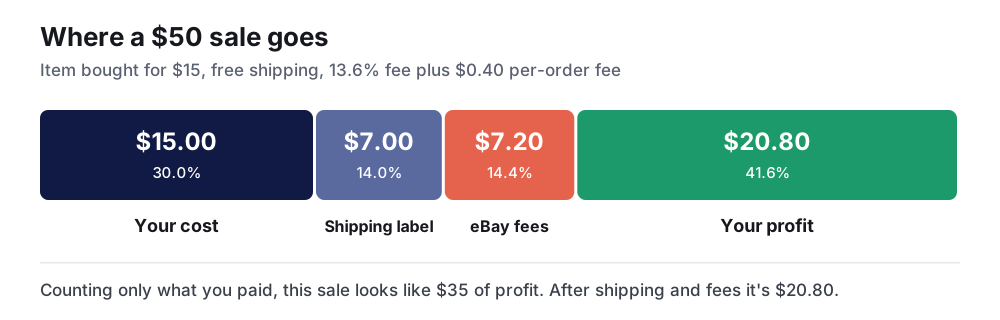
Your break-even price on this jacket is $25.93. Below that, you lose money. Listing at $37.50 would leave you roughly $10 after fees, which is the kind of reverse calculation the fee calculator does for you.
Why cheap items are so hard
The per-order fee is fixed, so it takes a bigger bite out of small sales:
| Item price | eBay fees | Fees as a share of price |
|---|---|---|
| $10 | $1.66 | 16.6% |
| $25 | $3.80 | 15.2% |
| $50 | $7.20 | 14.4% |
| $100 | $14.00 | 14.0% |
(No shipping or sales tax in this table. Both push the real number up.)
A $12 item with $4.50 charged for shipping, bought for $2 and shipped with a $4 label, nets about $7.86. That can still be worth it, but only if the listing takes you a couple of minutes, not twenty.
Other costs that eat profit
The two fees above aren't the whole picture. Depending on how you sell, you may also pay:
- Insertion fees. eBay gives many accounts a monthly allowance of free listings, then charges a small fee per extra listing. Check your own allowance.
- Promoted Listings fees. Optional. You choose an ad rate, and you're charged only when a sale comes through the ad.
- Store subscription. Worth it only if the lower rate and extra listings pay for it at your volume.
- Returns. If an item arrives not as described, you'll usually cover return shipping. See how to describe condition honestly.
- Income tax. Your profit counts as income. Keep records, and ask a tax professional how it applies to you.
How to protect your margin
- Know your break-even before you list. Work out the lowest price that still pays you, then price from sold listings rather than asking prices.
- Count real shipping. Weigh the item, pick the package, and price the label. Guessing is how $4 items turn into $9 shipments.
- Set a minimum profit per item. Many resellers pick a number such as $10, or a margin they're comfortable with, and pass on anything below it.
- Bundle low-value items. Two $8 items shipped together pay one per-order fee and one label.
- Check your category's rate. A few categories cost more or less than the standard rate, and it changes what a good buy looks like.
Keep reading
How to Price eBay Items Using Sold Listings (Step by Step)
Active listings show what sellers hope for. Sold listings show what buyers actually paid. Here's how to use them to price quickly without leaving money on the table.
How to Write an eBay Title That Gets Found (80 Characters, With Examples)
Your title is the main thing eBay's search matches against. Here's a simple formula for using all 80 characters well, with before-and-after examples.
How to Take eBay Photos With Your Phone That Actually Sell
You don't need a camera or a studio. Good light, a plain background and a short shot list are enough to make a phone photo that sells.